HomeDigital Property Infrastructure™CubeSquareInvestorsInsightsCompanyContact
More
TechnologyRegulatory & DisclosuresSpeaking & EventsPrivacy Policy
retokens@meridiansquare.global +1 888-430-4039

Our Thesis

Tokenization Is Becoming Easier. Property Infrastructure Isn’t.

Blockchain can create a digital representation of an asset. It cannot, by itself, determine whether that representation remains legally connected to the property, the owner, the investor and the authoritative records behind it.

That distinction will determine whether real-estate tokenization remains a collection of individual products — or becomes institutional infrastructure.

The Core Problem

The Token Is Only One Record

Consider what happens after a real-estate asset is tokenized.

  • A mortgage is recorded
  • A tax lien attaches
  • A deed changes
  • A property is refinanced
  • An investor becomes ineligible
  • A wallet changes
  • A transfer occurs
  • A regulatory restriction changes

The blockchain can continue operating perfectly while the legal reality surrounding the asset has changed.

Immutability without synchronization can create an accurate record of an outdated reality.

That is the problem Digital Property Infrastructure™ addresses.

The Architecture

Five Records Must Remain Connected

These records do not need to become one database. They need to become interoperable.

The Stack

The Digital Property Infrastructure™ Stack

Property Infrastructure

  • Public-record modernization
  • Title and ownership verification
  • Lien and encumbrance intelligence
  • Property-data normalization
  • Registry and external-system APIs

Identity & Compliance Infrastructure

  • Digital identity
  • Entity verification
  • Investor eligibility
  • AML and sanctions controls

Digital Ownership Infrastructure

  • Programmable ownership
  • Transfer controls
  • Digital ownership ledgers
  • Custody connectivity

Market & Lifecycle Infrastructure

  • Regulated distribution
  • Settlement
  • Marketplace connectivity
  • Distributions and servicing
  • Lifecycle reconciliation
  • Regulatory reporting
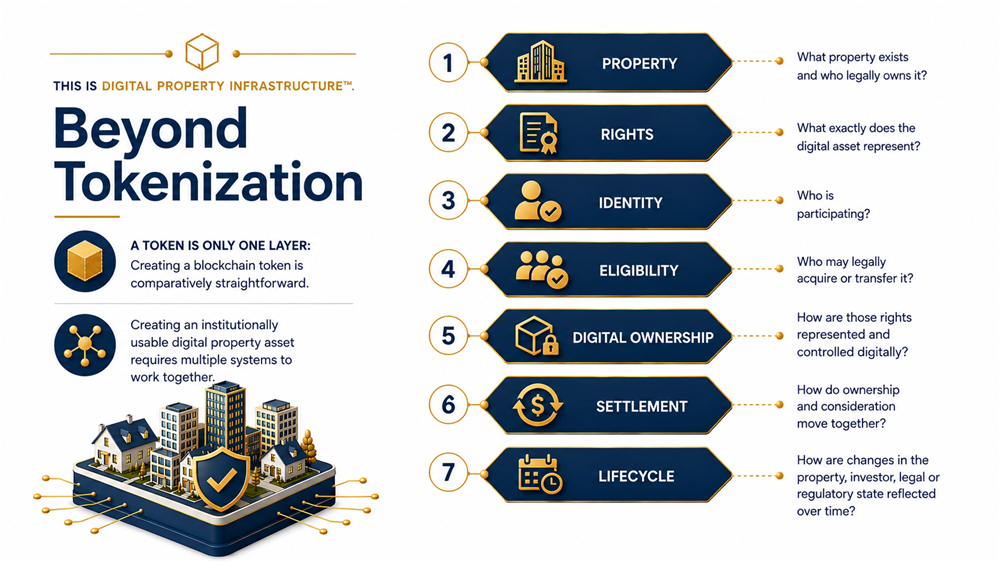
Beyond tokenization: property, rights, identity, eligibility, digital ownership, settlement and lifecycle layers.

Global Research

Different Markets Are Solving Different Layers

Different architectures. Same fundamental requirement — the digital record must remain connected to the rights that give it value.

United States

The U.S. Makes the Synchronization Problem Visible

In the United States, property-linked digital assets can depend on multiple authoritative systems remaining aligned:

These records do not need to become one database. They need to remain synchronized.

That synchronization problem is one of the clearest examples of why tokenization alone is not enough.

Our Research Standard

Announced ≠ Tokenized ≠ Invested ≠ Liquid

We distinguish between announced intentions, regulatory authorization, pilots, assets actually issued, capital actually subscribed, legally enforceable rights, repeat issuance and actual secondary-market activity.

As tokenization moves from narrative to infrastructure, those distinctions matter.

Our Thesis

The next generation of real-estate tokenization will not be defined simply by which blockchain wins.

It will be defined by infrastructure capable of coordinating:

Property law+Registries+Identity+Financial regulation+Digital ownership+Settlement+Capital markets

MeridianSquare intends to build that coordination layer.